
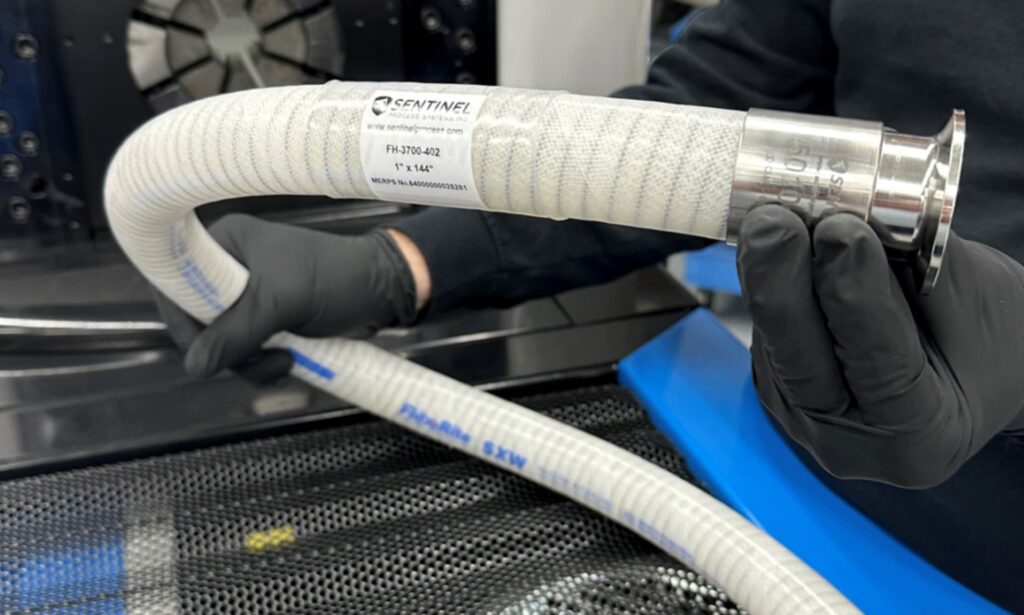
A process hose may appear to be a simple component, but in sanitary and high-purity systems, its performance can affect product transfer, equipment compatibility, uptime, and documentation requirements.
That is why reliable process hose fabrication starts well before the first fitting is crimped.
Process hose fabrication involves selecting, cutting, configuring, connecting, testing, and documenting a hose assembly for a specific application. Reliable fabrication accounts for the hose material, operating conditions, fittings, dimensions, testing requirements, and traceability needs of the process.
Start With the Application
A good hose assembly begins with a clear understanding of how and where it will be used.
- What product or media will it carry?
- What pressure, vacuum, and temperature conditions will it experience?
- Will it be cleaned or sterilized in place?
- How frequently will it flex or be repositioned?
- What types of fittings are required?
These details help define what the finished assembly needs to accomplish. They can also reveal requirements that are easy to overlook when simply replacing an existing hose. Looking at the complete application helps ensure that material, dimensions, fittings, and overall configuration are selected around the actual process requirements.
Select the Right Hose Material and End Connections
Hose Material Considerations
There is no single hose construction that is right for every sanitary process. Depending on the application, material options may include platinum-cured silicone, TPE, rubber, PVC, or fluoropolymer-lined hose. Each material offers different characteristics for chemical compatibility, temperature resistance, flexibility, pressure capability, and cleaning or sterilization requirements. Selecting the appropriate hose material starts with understanding the conditions the assembly will experience in service.
Depending on flexibility and pressure requirements, there are different reinforcement options including fabric mesh, wire mesh, and spiral helix.
Process Hose Fitting Options
The end connections matter just as much. Tri-clamp, ANSI flanged, cam-lock, MNPT, and FNPT fittings are among the connection options available for process hose assemblies.
The correct connection type depends on how the hose will interface with the surrounding equipment and piping. Choosing the proper fittings helps ensure the finished assembly connects securely and integrates properly into the process.
Custom Assembly Dimensions and Configuration
Hose material and fittings are only part of the specification. Length, diameter, fitting orientation, and overall configuration can all affect how the finished assembly fits, connects, and performs within the system.
This is where experienced design assistance can make a difference. Rather than working around a standard hose that does not quite fit the application, a custom assembly can be configured around the actual process requirements.
Controlled Fabrication and Crimping
Once the hose is specified, fabrication quality becomes critical. Precise measurements and consistent fitting installation help create an assembly that performs as intended.
SPS fabricates process hoses in-house at its Hatboro, Pennsylvania facility and maintains inventory of raw hose materials and end connections to support both standard and custom requirements.
A key part of SPS’ fabrication method is its controlled crimping process. Rather than relying on only a few compression points, the hose is rotated through 360 degrees while the fitting is incrementally crimped multiple times. This helps produce a uniform crimp around the circumference of the fitting – to ensure a leak-proof attachment of the fitting.
Pressure and Leak Testing the Finished Assembly
Fabrication should not end when the sanitary process fittings are installed. Before delivery, SPS-fabricated hoses undergo pressure and leak testing as a final check of the completed assembly.
This helps verify that the fitting-to-hose connection maintains integrity before the assembly is placed into service. In applications where uptime, cleanliness, and reliability matter, confirming assembly integrity before installation can help reduce avoidable issues in the field.
Support the Assembly with Documentation and Traceability
For pharmaceutical, food and beverage, specialty chemical, and other regulated or high-purity operations, the physical hose is only part of the requirement. Documentation and traceability can be equally important.
As part of SPS’ ISO 9001:2015-certified quality management system, hose assemblies can be supported with serialization, assembly and lot traceability, certification packages, and additional identification options.
SPS also uses durable vinyl identification labels protected by a self-sealing silicone overwrap. Available in over 13 colors, the vinyl label can be color-coded to the application, helping users identify which hose to be used each time. This helps preserve clear, legible hose identification in demanding processing environments, supporting accurate traceability while helping reduce the risk of mix-ups or identification errors.
Build a Process Hose Around Your Application
A dependable process hose assembly is the result of several decisions working together: understanding the application, selecting the right hose and connections, fabricating the assembly consistently, verifying its integrity, and providing the documentation the process requires.
With in-house fabrication, testing, inventory, and documentation capabilities, SPS supports both standard and custom hose requirements for sanitary and high-purity applications. Whether you’re planning a new installation, replacing an existing assembly, or responding to an urgent requirement, our team can help configure a hose around your process.
Need a process hose assembly built around your application? Contact SPS to discuss hose materials, fittings, dimensions, testing, traceability, and custom fabrication requirements.